Running in Miami's summer heat: a survival guide
Practical advice for the four months a year when Miami running feels less like a hobby and more like a survival skill. Timing, hydration, routes, and pacing from coaches and locals.
There is a moment on your first Miami July run when the math stops working. It is 84 degrees at 7 a.m., the humidity is 88 percent, and a quarter-mile in, your heart rate is already where it should be at mile three. The air does not feel like fresh air. It feels like something you have to push through.
This is not a guide that promises you'll love hot-weather running. Most Miami runners describe a July long run with words their grandmothers would not approve of. The point is to keep training without overheating, without missing a week, and without quietly deciding you're "not really a runner anymore." All of that is doable. It mostly comes down to four decisions: when you run, where you run, how you hydrate, and how honest you are about pace.
Why Miami summer running is harder than you think
Heat alone isn't really the story. Humidity is. The reason your January easy pace feels like a tempo in July isn't fitness loss; it is the combination of temperature and air saturation that Miami's summer delivers. The pace is the same. The effort is much harder. Coaches who train athletes in Florida talk about this constantly: your effort is real, your pace just lies about it.
Add direct sun, plus asphalt and concrete that hold heat well past sunset, and you have the Miami summer cocktail. A run that would be unpleasant in Boston can be genuinely risky here without the right plan.
Time it right: before sunrise or after sunset
Local coaches give the same advice, in roughly the same terms. Run before 6:00 a.m. or after 6:30 p.m. In June through September, the sun does almost all the work, and getting out of its way is the single biggest decision you make.
A 5:30 a.m. run in July is genuinely different from a 7:30 a.m. run in July. The temperature difference is small, but the radiant load is enormous. Same idea on the back end: even at 88 degrees, an 8:00 p.m. start with the sun down is workable. The same workout at 5:00 p.m. is a sweat lab.
If a morning crew helps you actually get out the door, that's a force multiplier. Many Miami run clubs run at 5:45 or 6:00 a.m. through the summer for exactly this reason.
Pick a shaded or water-adjacent route
Once you've fixed the timing, the route itself matters more than you'd expect:
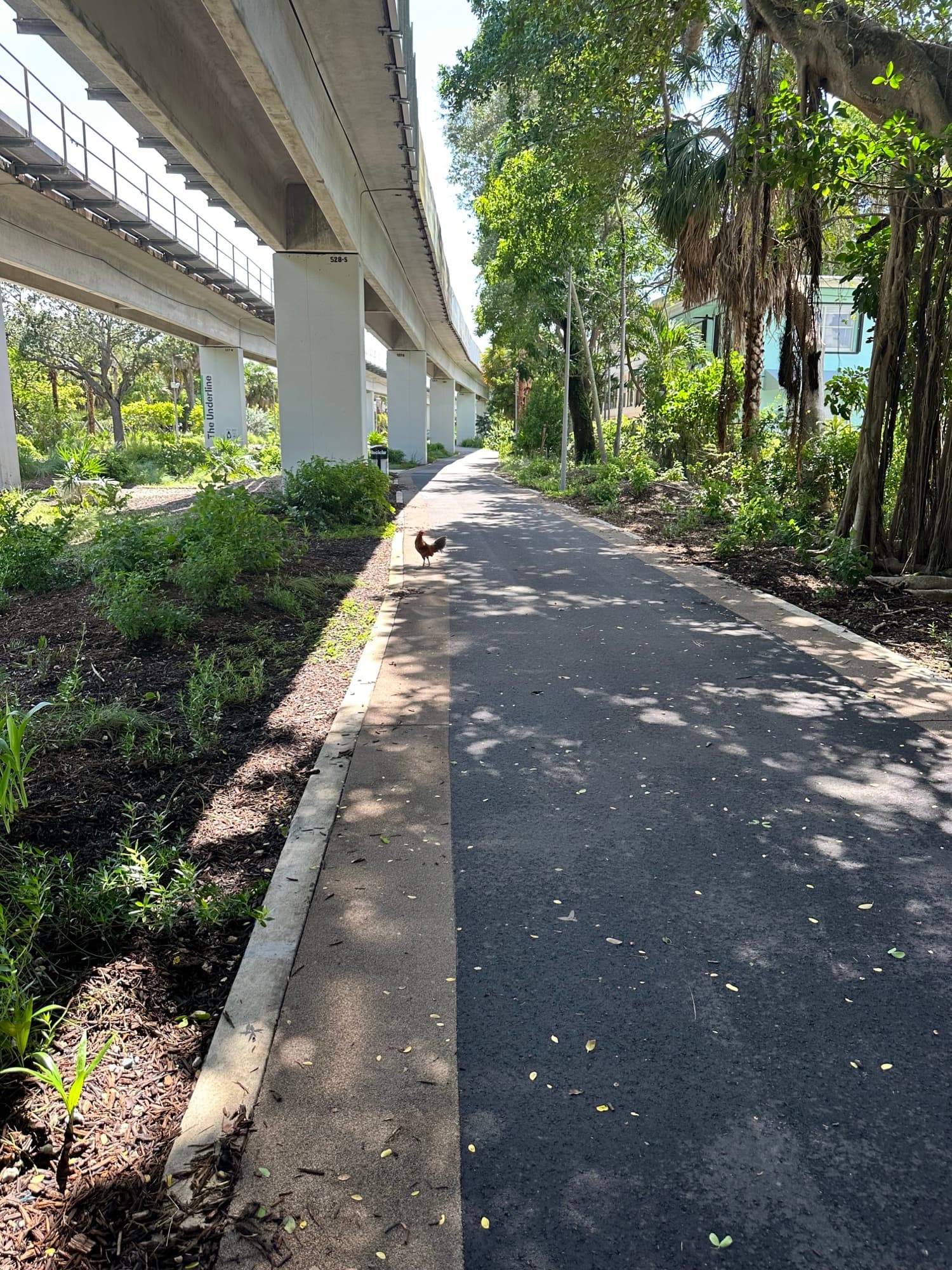
- Shade is real. The Old Cutler Rd. bike path is shaded almost the entire 20 miles south of the Key Biscayne causeway entrance. The Underline, the linear park running under the Metrorail from Brickell south, is fully shaded with neighborhood waypoints every mile or so. North Shore Open Space Park (between 79th and 87th Streets) has tree-cover stretches. All three feel meaningfully cooler than open beach.
- Wind helps. The Miami Beach Boardwalk and Key Biscayne (Rickenbacker Causeway, Crandon Park) get more ocean breeze than inland routes. Same air temperature, very different perceived effort.
- Loops beat point-to-points. A loop lets you cache water in one spot and lap past it every mile or two. A point-to-point forces you to carry everything or hope a water fountain works.
Browse Miami running routes for shaded and oceanfront options with full maps and turn-by-turn details.
🔥 Five-point pre-run checklist for Miami summers. Run through these before you head out the door, every time, June through September.
- Water in your hand or on the route. Roughly 0.1 oz per pound of body weight 30 to 60 minutes beforehand (a 150-pound runner needs about 15 oz, a 200-pound runner closer to 20). Carry more if the run is over 45 minutes, and add electrolytes (sodium, potassium, magnesium) for anything over 60 minutes.
- Hat and sunglasses on. Not optional. A wet visor cools you off, and shade on your eyes reduces squinting fatigue.
- Sunscreen applied 15 minutes before. SPF 30 minimum, reapplied at the halfway turn if you're out for a long run.
- Phone with a charge. For find-my-friends in case you bonk and need a ride, and for actual heat-emergency calls. People do collapse on summer runs.
- An honest expectation about pace. You'll be 30 to 60 seconds per mile slower than your spring race pace at the same heart rate. Plan for that.
Hydrate like it matters (it does)
Pre-hydration is the part most runners overlook. A common rule of thumb is to drink water 30 to 60 minutes before heading out, with body weight as the multiplier: roughly 0.1 oz per pound (about 15 oz for a 150-pound runner, closer to 20 for a 200-pounder). Many local runners add a pinch of salt or an electrolyte tab. The idea isn't to drink your way out of dehydration mid-run; it is to stay ahead of it.
During the run, the standard guidance from running coaches is 4 to 8 oz every 15 to 20 minutes for anything over 45 minutes, with heavier runners and harder efforts at the high end. Carry a handheld bottle or run a loop past a water cache. Most coaches in heat-prone areas emphasize electrolytes (especially sodium) for summer runs longer than an hour.
After a long summer run, a common practice is to weigh yourself. A pound of weight loss is roughly 16 oz of fluid lost, and coaches generally recommend replacing it slowly with an electrolyte-containing drink over the next hour or so rather than chugging plain water.
Slow down. Your pace will lie to you
The biggest mindset shift is measuring effort by heart rate or perceived exertion rather than pace. Runners often find their summer easy pace lands a full minute per mile slower than the winter version at the same heart rate. That gap isn't fitness loss, it is the conditions.
If you train with a watch, running by heart-rate zones is a common approach. If you don't, the talk test is the simple version: an easy run is one where you can hold a full sentence comfortably. Anything harder than that on a hot July morning tends to be overreaching.
Many local coaches suggest treating summer as a base-building season rather than a PR-chasing one: easy aerobic mileage, structural strength, and patience with the workouts. The hard intervals can wait for October when the morning air is back in the 70s.
Dress for it
Most Miami runners agree on roughly the same packing list for summer mornings:
- Light colors. White, gray, pale blue. Dark colors hold more heat in direct sun.
- Moisture-wicking only. Cotton stays wet, heavy, and uncomfortable. Synthetic or merino is the default.
- Hat or visor. A visor lets heat escape from the top of the head; a closed hat traps it.
- Body glide. Chafing in Miami humidity is its own kind of misery. Apply before the run, not after.
- Sunscreen rated for sweat. Cream-based SPF 30+ that won't run into the eyes by mile three.
When the heat is still too much
Some weeks the heat is going to win. Plan for those:
- Treadmills exist. An air-conditioned 5-miler at a 1% incline is a better workout than a skipped 8-miler.
- Pool running counts. Aqua jogging in deep water is a common heat-week substitute. Most Miami municipal pools have early-morning lap swim windows; Flamingo Park Pool on South Beach and Venetian Pool in Coral Gables are common picks. Check their schedules before you go.
- Cross-train. Spin classes and indoor rowing keep your aerobic base honest through August, even if you skip a week of running.
⚠️ Know the difference between heat exhaustion and heat stroke. Both can hit fast on a Miami summer run, and the treatments are different. The clinical descriptions below come from the National Athletic Trainers' Association position statement on exertional heat illnesses (Casa et al., 2015).
Heat exhaustion, per NATA, presents as:
- Fatigue and weakness
- Headache, dizziness, lightheadedness
- Nausea or vomiting
- Low blood pressure and impaired muscle coordination
- Core body temperature typically under 105°F (40.5°C)
NATA's on-site response: stop, move to a cool or shaded area, lie supine with legs elevated, and cool the skin with fans, ice towels, or cool water on the head and neck. Remove excess clothing or gear. NATA recommends transferring care to a physician if there is no recovery within 30 minutes.
Heat stroke is the medical emergency. NATA's diagnostic criteria:
- Core body temperature above 105°F (40.5°C)
- CNS dysfunction such as confusion, disorientation, loss of balance, staggering, irrational behavior, collapse, or loss of consciousness
- Hot and wet skin, hyperventilation, hypotension, and dehydration
Call 911 immediately and begin cooling. NATA reports that when core body temperature is normalized (brought below 102°F / 38.9°C) within 30 minutes of collapse, typically via cold-water immersion up to the neck, a 100% survival rate with limited or no lasting effects has been reported.
Find your morning crew
The single biggest predictor of whether you train through a Miami summer is whether anyone is expecting you at 6 a.m. Run clubs are the lever. Browse run clubs in Miami for groups that meet at sunrise, including options in Brickell, South Beach, Coconut Grove, and Wynwood. Most welcome all paces. Most run year-round.
If you're targeting a specific race, check the Miami event calendar for everything from 5Ks to the Life Time Miami Marathon in January 2027. The right goal race makes the boring base miles in August feel like they're for something.